Phuket traffic follows its own rhythm, and the first hour on the island is where most of the adjustment happens. Left-hand traffic, busy junctions and a constant flow of scooters all take getting used to.
This guide covers the habits that keep you safe in that flow, from reading junctions to holding your position, without pretending the roads are anything other than busy.
Getting used to left-hand traffic
If you normally ride on the right, the first few minutes feel wrong. Left-hand traffic changes which way you look first and where you position yourself in a lane.
Start somewhere quiet to let the habit settle before you join a busy road. A short loop near your accommodation is worth the time.
Keep reminding yourself which way traffic comes from at junctions until it stops being something you have to think about.
Give yourself a short quiet loop near where you are staying, and the unfamiliar side of the road stops feeling strange surprisingly quickly. Mirror checks before every change of line cost nothing and reveal the scooter that has quietly appeared alongside you.
Reading the junction ahead
Most risk on the island gathers at junctions, where scooters, cars and pedestrians all arrive at once. Seeing the junction early is half the work.
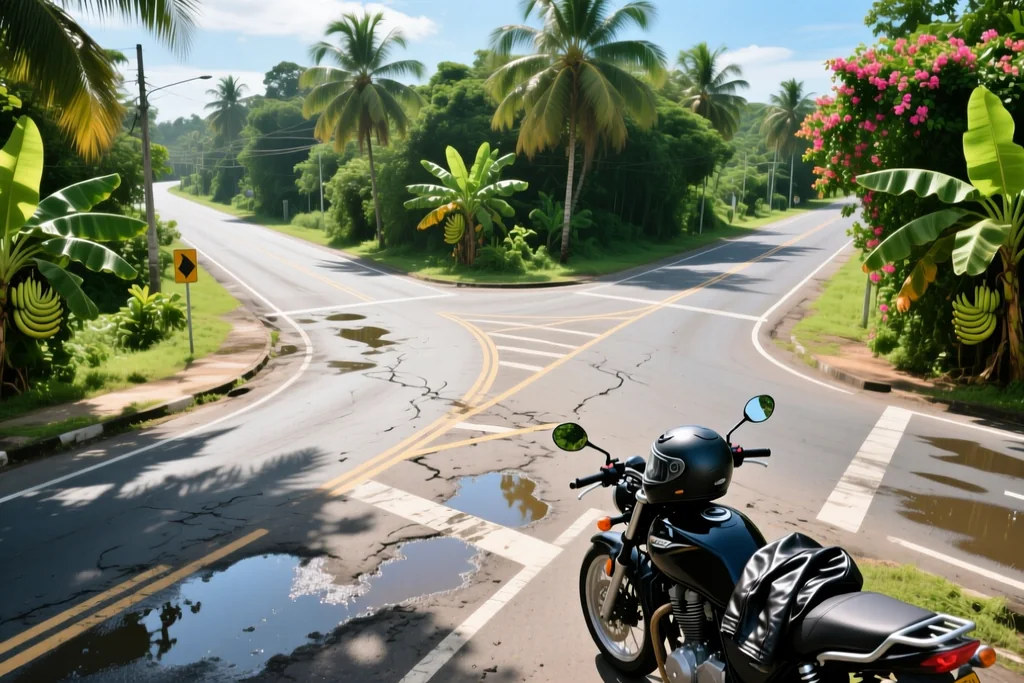
Cover the brake as you approach, look for movement rather than for signals, and assume someone will cross your path.
Position yourself where you can be seen, not hidden behind a larger vehicle that is about to turn.
The junction is where most trips go wrong, so slowing a little on approach buys you the time to read the movement and react calmly. Riding a little slower than the traffic around you is far safer than trying to match the fastest rider at the front.
Holding your position in the flow
Traffic here moves in a way that can look chaotic until you read it as a flow. Riders fill gaps and filter forward, and holding a steady position helps you move with it.
Be predictable. Sudden changes of line surprise the people around you far more than a steady pace ever will.
Leave a gap in front. It costs you nothing in the flow and gives you room for the unexpected.
Being predictable is the single most useful thing you can do in heavy traffic, because everyone around you can then plan around you. Giving a car ahead plenty of room lets you brake gently when it stops, rather than reacting only at the last moment.
Turning across oncoming lanes
Turning across oncoming traffic is one of the most demanding moves on the island. It needs a clear view, a decisive moment and no hesitation.
Only commit when you can see the road is clear, and once you commit, do it without drifting or stopping halfway.
If you cannot see, wait. A missed turn costs a minute; a rushed one costs much more.
A decisive turn made at the right moment is far safer than one made slowly or twice, so wait for the gap and then use it fully. Wet roads simply magnify every habit, so everything that works in the dry is worth doing a little earlier and softer.
Speed, spacing and the conditions
Speed is the factor you control most directly, and it decides how much time you have to react. On busy island roads, a little less speed buys a lot more safety.
Spacing matters just as much. Keeping room around you gives you somewhere to go when someone else makes a mistake.
Adjust both for the weather, because a wet road is a different road and asks for more of everything.
Speed and spacing work together, and giving yourself room in front is often the same thing as giving yourself time to think.
| Situation | The risk | The habit |
|---|---|---|
| Junctions | Vehicles crossing your path | Cover the brake and look for movement |
| Busy flow | Being hidden or surprised | Hold a steady, predictable position |
| Turning across | Hesitation or a rushed move | Commit only with a clear view |
| Wet roads | Less grip and more spray | Reduce speed and increase spacing |
The first hour and the first day
The first hour is where you set the tone for the whole trip. Riding somewhere quiet before the traffic is the simplest way to start well.
Stick to roads you can handle and build up as your confidence grows, rather than proving something on day one.
A calm start is not caution for its own sake. It is how experienced riders get comfortable on unfamiliar roads.
There is no need to prove anything in the first hour, and the riders who take it gently on day one usually enjoy the week far more.
Riding in Phuket traffic: the habits that keep you safe
Related guide on this topic.
Habits that carry the whole trip
A few habits, once formed, keep you safe for the rest of your stay. Look far ahead, keep a gap, and be the rider others can predict.
Wear a helmet, keep your lights on and your documents with you, so a roadside check is a short conversation rather than a problem.
Ride within your own limits, and let the traffic flow around you instead of trying to beat it.
Formed early, those habits carry the whole trip, so the roads that once looked chaotic come to feel like an ordinary part of the day.
- Start somewhere quiet to get used to left-hand traffic before joining busy roads.
- Cover the brake and look for movement as you approach every junction.
- Hold a steady, predictable position and keep a gap in front of you.
- Turn across oncoming traffic only when you can see clearly and commit fully.
- Adjust your speed and spacing for the weather, and ride within your limits.
Riding in Phuket traffic is a skill that grows quickly once you learn the flow and trust a few simple habits.
Start slow, stay predictable and keep your distance, and the island's roads become something you ride rather than something you fight.